


I grew up already knowing about Richard Burton well, Richard Jenkins because my dad adores him. Honestly, he might even be my dad’s favourite actor of all time. So when I watched Mr Burton, I went in with a kind of inherited familiarity. What I didn’t expect was just how moving and brilliantly crafted the film would be.
Mr Burton isn’t a traditional cradle-to-grave biopic. Instead, it focuses on the relationship that changed Richard Burton’s life: his bond with his former English teacher and eventual legal guardian, Philip Burton. The film zeroes in on mentorship, identity and the emotional cost of ambition showing how one man’s belief can shape the destiny of another.
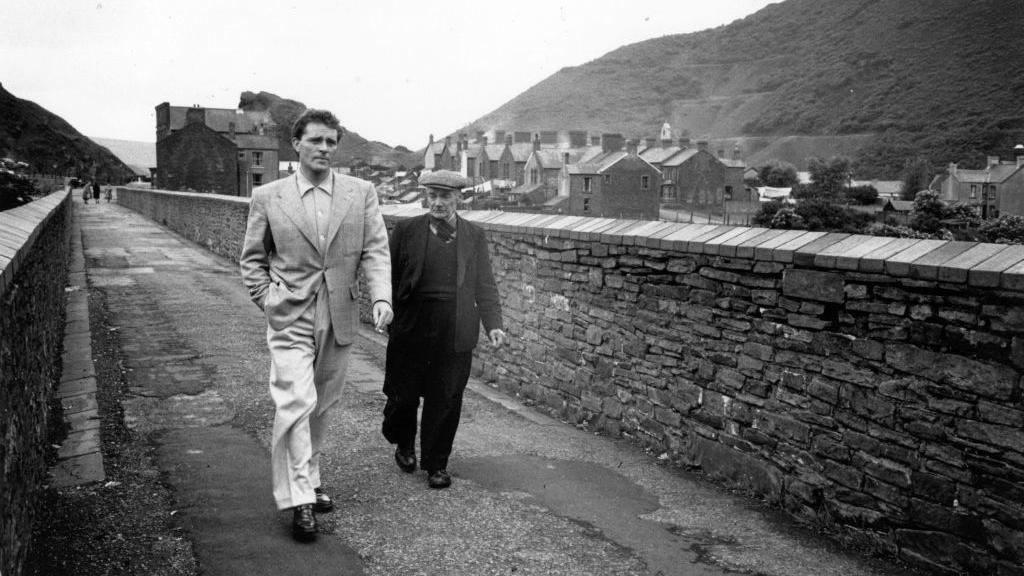
Richard’s childhood was loving but overwhelmingly difficult. His mother died when he was two; his father was an alcoholic; and from ages two to seventeen, it was his older sister who effectively raised him. But the true turning point in his life came in Port Talbot, where Philip Burton recognised something extraordinary in him. Philip coached him in acting, pushed him academically, became his guardian, and even gave Richard his surname so he could gain a teacher’s sponsorship to Oxford. It was a relationship both life-changing and complicated.
There were rumours about Philip’s intentions, but personally, I don’t believe them. My view and the film quietly supports this is that Philip’s motives were rooted in care, hope and an academic’s fascination with talent. I simply don’t think Richard would have stayed close to him until Philip’s death if something dark had happened.

The film also subtly gestures to the emotional pressures Richard carried into adulthood. This is my own interpretation, but his well-known drinking, smoking and womanising feel less like glamorous vices and more like armour: a response to growing up in a mining community where acting wasn’t seen as “man’s work,” the weight of expectation he placed on himself, and the guilt he carried especially his painful belief that he was somehow responsible for his daughter’s disability. None of this is stated outright in the film, but the emotional threads are there, woven quietly beneath the performances.
One line sums up Richard’s inner struggle. Speaking to Philip, he says:
“I owe you everything and I never said it to you, and I never really apologised. I am afraid. I am not like you. I am a bloody fake. I am half actor. I am jealous, proud, selfish, spiteful, and you are everything. You are extraordinary.”

It’s devastating. And it lands because Toby Jones (Philip) and Harry Lawtey (Richard) have astonishing chemistry. They capture the love, tension, admiration and unspoken regret that defined this relationship. Marc Evans’ direction is beautifully restrained, guiding the story without suffocating it. I’ll admit it I cried.
One of my favourite touches was the film’s use of Henry IV Part 2, showing Richard playing Hal onstage in Stratford while Philip watches from the audience. It’s a simple moment, but it says more than any monologue could about pride, paternal love and the distance between who we are and who made us.

There’s something endlessly fascinating about Richard Burton. After watching Mr Burton, you’re almost compelled to go deeper into documentaries, biographies, poetry recordings, anything that helps you understand this brilliant, flawed, magnetic man. The film gives you only a slice of his life, but it’s enough to make you want the whole story.
And when Richard tells Philip, “I owe you everything,” I felt that. It echoed something I feel toward my own dad the person who first introduced me to Burton at all. In a strange, emotional way, the film becomes not just a story about mentorship on screen, but a reminder of the people in our lives who quietly shape us.
And like Richard, I find myself saying: “I owe him everything.”