

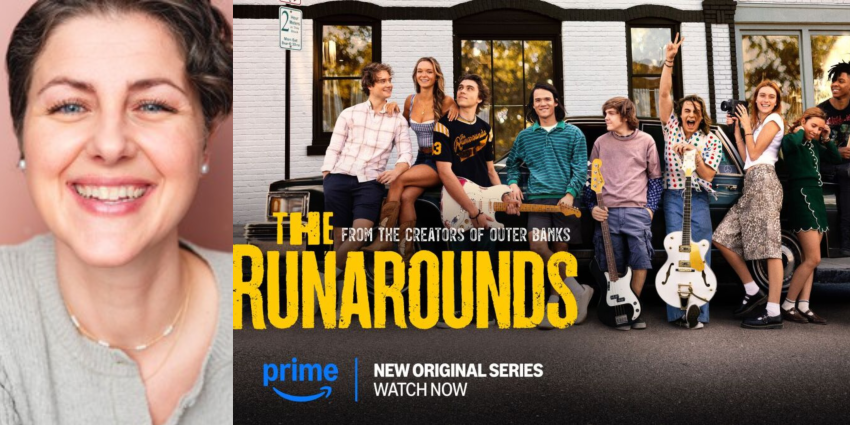

Dani’s journey to the screen is anything but traditional. From her early love of music to her career in the criminal justice system, Dani has brought all of those life experiences into her acting.
Now starring as Wendy Wysong in The Runarounds, she reflects on the role, her musical roots, memorable on-set moments, and what it’s been like to share the screen with legends like Kathy Bates.

Congratulations on your new TV Show the Runarounds, playing Wendy Wysong. Can you please tell me a bit about your role and the show itself?
What I can say about Wendy is that she’s a complicated person who, normally I would say is trying her best, but I’m not sure if she really is.
She’s a flawed human trying to make it through life, raising a child by herself without many resources, while struggling with her mental and physical health. That makes for some interesting dynamics, especially in situations that affect Wyatt and maybe even his friends. We’ll see where it goes.
Were you musical as a kid or did you have to have to learn an instrument whilst being in the role? (This interview was done before the release of the show)
Here’s what’s interesting: I grew up as a singer first. I started performing at the age of five and continued publicly until about 18, before heading off to college.
In college, my friends always forced me to sing whenever they’d have friends visit. They’d yell out my name and demand it. I’d fight it for a second and then inevitably give in and perform one of my go to songs, like “His Eye Is On The Sparrow” from Sister Act, “Weak” by the group SWV or “Smile” by Tamia.
When I went into my career in the criminal justice system, I suddenly realized one day, “Oh my gosh, I don’t sing anymore.” I got pulled into life and work and stopped performing, even though music has always been my first love.
Being part of The Runarounds is really special for me. I’ve even toyed around with some music elements when thinking about my character’s possible backstory and the pieces of her life that might have led to this dynamic with her son Wyatt. I recently discussed some of my ideas with one of the writers, so, who knows? Maybe if we get a season two, we could explore some different sides of her. I really hope so!

The show blends scripted drama with real-life musicianship. What surprised you most about how that dynamic played out on set?
How brilliant these boys are as musicians and how easily they stepped into acting.
At first, I was surprised, but then again, they’re such creative talents that it makes sense that acting would come naturally to them. I was so impressed with their work ethic and preparation. They took their acting coach’s lessons seriously and worked incredibly hard behind the scenes.
I’ve never been on a set with people who had never acted before, so this was a first for me. It worked beautifully. I adore those boys, and I love working with them.
Were there any memorable moments during production?
Yes, every time I stepped out of the transportation van and onto set, the crew and Jonas (the creator and often director) were always already there and greeted me with big hugs and excitement that I was back. It felt like a true family. That’s the best part of that set for me.

Did your passion for performing begin at a young age?
Yes, though I’ve always struggled with performance anxiety when I’m live in front of people. Singing was one of my favourite things, but I also loved sports and was very active growing up. I did a couple of community theatre shows as a kid, but for the most part, I identified more as an athlete than a performer.
In middle school, I was a competitive diver, and I was actually very good at it. Unfortunately, a back injury when I was 13 forced me out of diving early on. By my senior year of high school, I had sustained another back injury and had to discontinue sports altogether. That’s when I decided to take part in the high school musical. Even though I didn’t have a big role, I had a blast being in a creative environment like that with friends.
Later, when I was working in the criminal justice system, that pull toward performing kept resurfacing. I’d come home after long days in the field or in court and unwind by watching scripted television, and I’d catch myself thinking, I could do that. The role of Detective Debra Morgan on Dexter especially resonated with me, because I was a probation officer at the time and working directly in courtrooms. That background gave me a natural connection to the earlier roles I booked as police officers and various law enforcement officials.

How was being in law enforcement and working for the Circuit Courts before acting and did it prepare you for your roles in shows like FBI: Most Wanted and NCIS: New Orleans?
In those particular shows, not so much, since I was playing the person being pursued by law enforcement; however, in general, my background definitely helps when I play law enforcement roles.
I wasn’t a police officer, but I worked closely with them, so I know, generally, how they operate. There have been times on set when I’d say, “Guys, this isn’t realistic,” but ultimately, it’s scripted TV. There was this scene in The Sinner where Matt Bomer’s character goes to see his wife but has a restraining order and is suspected of some awful things. I was like “I’d never let him this close to her guys”. But then we wouldn’t have this amazing moment we see play out in the show.

What was it like working with Kathy Bates on Matlock and were you nervous working with such an iconic, Oscar winning actor?
Normally, I don’t get nervous about working opposite anyone because I’ve done my prep and I’m just excited to get to work. But Kathy Bates is someone I’ve admired for years, and when she walked into the room for the first table read, I’ll admit I was starstruck. She’s one of my absolute heroes, and it felt almost surreal to be sitting across from her.
That table read was packed, and I was at the other end of the room when she walked in. It was almost like a spotlight followed her. I thought to myself, Oh my God, I’m really going to be working with Kathy Bates. Afterward, the director asked me and another guest star to stay behind to go over a scene that hadn’t been part of our auditions. Kathy could have easily slipped out the side door and avoided all of us. Instead, she walked right over to us, leaned down, held out her hand, and said, “Hi, I’m Kathy. Thank you so much for being here. You guys are great.”
That gesture spoke volumes about her. She didn’t have to take that time, but she made sure to welcome us personally. When I wrapped after my two episodes, I went to thank her for the experience, and she told me I was terrific. That moment really stayed with me. To hear those words from someone I respect so deeply was incredibly validating and something I’ll carry with me for the rest of my career.
You’ve been open about being neurodivergent. How has that shaped your creative process and the way you approach roles?
I was clinically diagnosed last year and it was honestly life changing. Suddenly everything made sense – my quirks, the way I interact with people, my persistence, even the things that sometimes frustrates my friends and family. Ha! It was like a lightbulb went on, and I thought, Oh, this is a big part of why I am the way I am.
One of the biggest ways it shows up in my acting is through my attention to detail. I’ve always been hyper-aware of little things – how people move, their body language, the rhythm of their speech, even the smallest physical habits. When I’m building a character, I automatically pull those things in without thinking much about it. I often see layers in a script or character that might be easily overlooked. For me, it’s like a mini investigation or putting together a puzzle. I don’t just see the big picture, I see every tiny piece and how it fits or affects the others. It definitely helps bring more nuance and subtlety to my work.
I also think my neurodivergence has shaped my resilience. I don’t really accept the word “no”. I’m always like ok, let’s figure out how we get to a yes. I think that type of stubbornness has served me in the entertainment industry, where the path to yes is riddled with obstacles.
Honestly, learning about my neurodivergence gave me so much self-compassion. Instead of looking at my traits as flaws or being self-conscious about them, I can see them now as strengths that make me unique, as a person and as an actor. It’s become part of how I celebrate myself.
Is there a question that you wish an interviewer would ask but they never do?
Yes. I wish people asked: “What’s the thing you’re scared to tell people that you could open up about and finally be free of?”
I’m a big advocate for mental health, and I’d love to know other people’s answers to that. I don’t know if anyone would actually answer it, but it intrigues me nonetheless.
From her childhood performances to her work in the courtroom and now her career on screen, Dani Deetté has lived many lives, and she brings that depth to every role.
Whether she’s singing, standing tall as a law enforcement officer, or finding family on the set of The Runarounds, Dani continues to prove she’s more than an actor she’s a storyteller.