

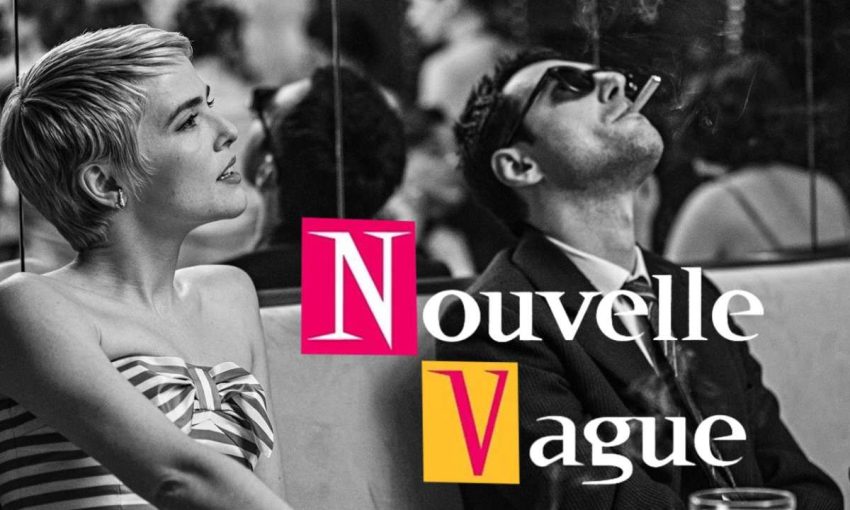

There’s something instantly charming about a film that begins with its actors sitting in a cinema watching a movie. It pulls you right into its world, like you’ve slipped into the seat beside them. Nouvelle Vague does exactly that, and from the opening scene I knew I was in for something funny, clever, and unexpectedly engaging.
A subtitled French film shot in gorgeous black and white might sound niche, but trust me this one feels universal. The cinematography is absolutely stunning, drenched in that soft, smoky atmosphere that makes you fall in love with movies all over again. And fittingly, the film itself is about falling in love with filmmaking. It steps behind the scenes of Jean-Luc Godard as he creates his revolutionary 1960 debut, Breathless, and becomes a full-on love letter to the entire French New Wave movement.

One of my favourite stylistic choices is the use of still images to introduce new characters. It feels playful and cool, like flicking through a vintage photography book where every freeze frame has its own attitude. It also fits the film’s spirit perfectly half documentary, half dream.
The script is genuinely brilliant. There are lines that make you sit up, like the reminder: “Don’t regard cinema as mystic.” There’s something so bold about that statement, especially coming from a film about one of cinema’s most mythologised directors. Honestly, watching this made me think I need to dive into more French films in general.

Zoe Deutch is incredible as Jean Seberg, capturing her lightness and vulnerability without ever slipping into imitation. Guillaume Marbeck as Jean-Luc Godard is just as captivating sharp, eccentric, stubborn, and completely magnetic. I also loved the chemistry between Zoe Deutch and Aubry Dillun, which adds an unexpected romantic warmth that echoes the tone of early New Wave cinema.
Part of why the film works so well is because I truly didn’t know what to expect going in, and I was pleasantly surprised at every turn. There’s a moment where Godard begins shooting Breathless, and he does, one take just one and decides it’s done. It’s funny, a little chaotic, and absolutely perfect for capturing who he was: a critic turned director, someone who lived and breathed cinema in his own very specific way.

This is one of those films that’s almost hard to review because it’s so engaging you forget to think critically at all. You just want to sit there and soak it in. It has this romantic, wistful feel that sneaks up on you romantic not just in the sense of love, but in the sense of loving film itself.
And the ending without spoiling anything adds an extra layer by letting Richard Linklater gently guide us through what happened to the real people after the credits would normally roll. It’s thoughtful and surprisingly emotional.

Watching Nouvelle Vague made me realise how much we need more films like this films that take risks with their storytelling, lean into style and feeling, and aren’t afraid to be a little experimental. There’s something magical about a movie that trusts its audience, that invites you into the creative process instead of spelling everything out. Nouvelle Vaguedoes exactly that, and it reminds you that cinema can still surprise you when filmmakers dare to push the frame a little further.
Nouvelle Vague isn’t just one of my favourite films of the year. It’s proof that when filmmakers take risks, the result can be something genuinely unforgettable.
Nouvelle Vague arrives in cinemas across the UK and Ireland on 30th January 2026
1 thought on “A LOVE LETTER TO CINEMA : FALLING FOR NOUVELLE VAGUE ALL OVER AGAIN”